
Photo: Photographer: unknown Restored by: Bammesk / Wikimedia Commons, Public domain
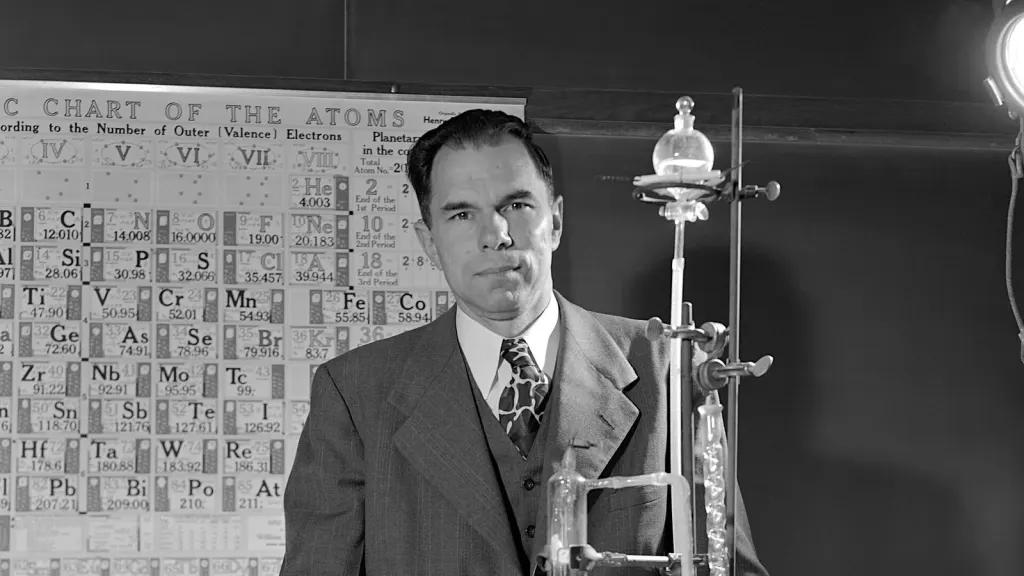
Glenn Theodore Seaborg was born in Ishpeming, Michigan, on April 19, 1912, and moved with his family to California at age 10, according to his biography at NobelPrize.org. He earned a degree in chemistry at UCLA and a Ph.D. in chemistry from the University of California, Berkeley, in 1937.
From 1937 to 1939 he was the personal laboratory assistant of G.N. Lewis, with whom he published several papers. Berkeley appointed him an instructor in chemistry in 1939, an assistant professor in 1941 and a professor in 1945. In 1946 he took charge of nuclear chemical research at the Lawrence Radiation Laboratory, and from 1954 to 1961 he was its associate director.
Seaborg took leave from the university from 1942 to 1946 to lead plutonium work for the Manhattan Project at the University of Chicago’s Metallurgical Laboratory. The Nobel biography credits him as co-discoverer of plutonium and of all the transuranium elements through element 102, and says he and his colleagues identified more than 100 isotopes across the periodic table. He also proposed the actinide concept, which showed how the heavy elements fit into the periodic table as a series analogous to the rare earths. He received the 1951 Nobel Prize in Chemistry and the Atomic Energy Commission’s Enrico Fermi Award in 1959.
In 1958 he became chancellor of the University of California at Berkeley, serving until President John F. Kennedy appointed him to the Atomic Energy Commission in 1961 and named him its chairman. Seaborg died on Feb. 25, 1999.
This profile draws only on the Nobel Foundation’s biography, which was written at the time of the award and later updated with his death date.